
By Janice Tolj · Updated July 16, 2026
This page contains affiliate links. If you make a purchase through them, we may earn a commission at no extra cost to you. Our recommendations are based on independent research and genuine assessment of product value for seniors. Prices and availability may change – always verify current information before purchasing.
Joint-friendly equipment for strength, cardio, balance, and recovery — reviewed for safety, effectiveness, and real-world use at home
Updated: June 2026 | HealthEssentialsAfter50.com
The best fitness gear for seniors is resistance bands, the best overall value pick at $15 to $50. A recumbent bike is the best cardio machine at $250 to $1,800, the BOSU Balance Trainer is best for active balance training and fall prevention at $100 to $150, and a foam roller is best for muscle recovery at $15 to $50.
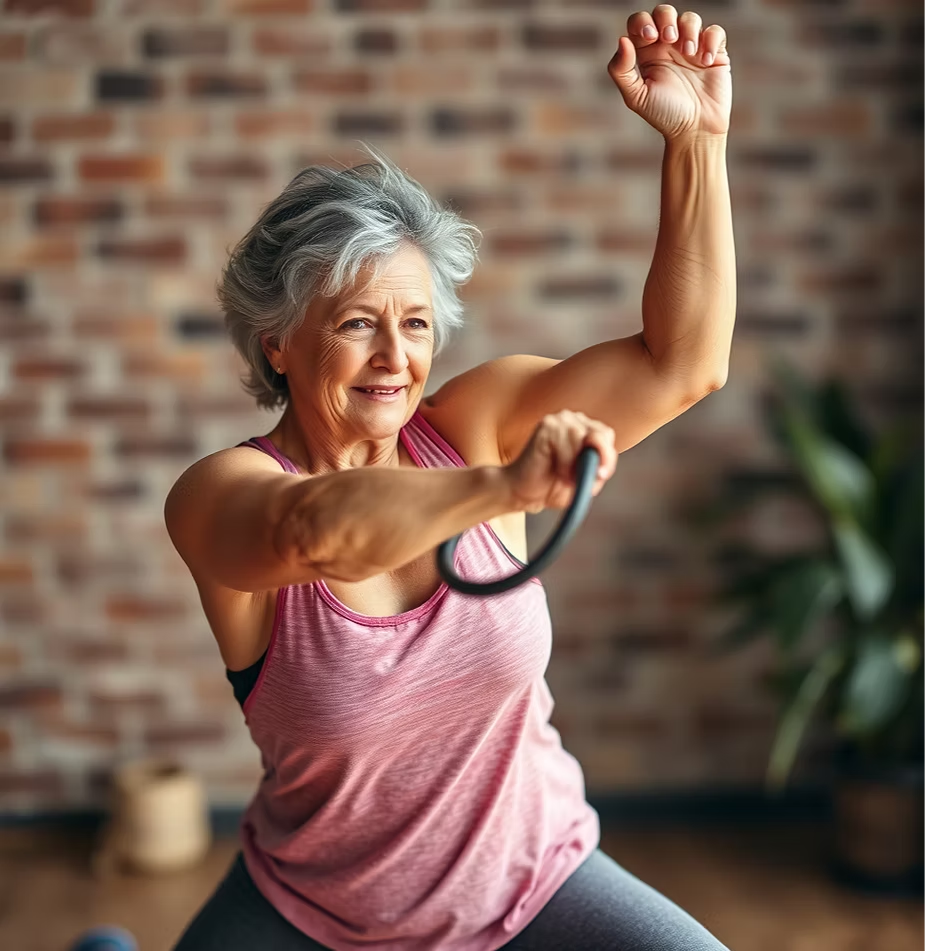
Why the Right Fitness Gear Changes Everything After 50
Here is what no one tells you clearly enough: the biggest obstacle to staying fit after 50 is not motivation. It is friction. The wrong equipment makes every workout harder to start, more likely to cause pain, and easier to quit. The right equipment does the opposite — it removes the barriers between intention and action.
After 50, the fitness equation shifts. Joint health becomes a non-negotiable priority. Muscle mass declines at roughly one to two percent per year — a process called sarcopenia — unless you actively work against it. Balance deteriorates in ways that directly affect fall risk, which is the leading cause of injury-related death in adults over 65. Recovery takes longer. And the equipment you used at 35 may not be appropriate, accessible, or safe at 55 or 65.
This guide is built around those realities. Every piece of equipment reviewed here has been selected because it delivers meaningful fitness benefit for older adults while respecting the physical constraints that come with age. We have organized it by fitness category — strength, cardio, balance, and recovery — and included a full comparison chart so you can see at a glance which gear fits your goals, your budget, and your body.
We do not sell a preferred brand. We explain what works, what to look for, and what to avoid.
What Regular Exercise Actually Does for Adults Over 50
The evidence on this is not subtle. According to the Centers for Disease Control and Prevention, older adults should aim for at least 150 minutes of moderate aerobic activity per week, plus muscle-strengthening activity on two or more days. The payoff for hitting those targets is substantial:
- Sarcopenia prevention: strength training two to three times per week significantly slows age-related muscle loss, preserving the functional strength needed for daily independence.
- Bone density: weight-bearing and resistance exercise stimulates bone formation, reducing fracture risk in adults with or at risk for osteoporosis.
- Fall prevention: balance training and lower-body strength work are among the most effective evidence-based interventions for reducing fall risk in older adults.
- Cardiovascular health: regular aerobic exercise lowers blood pressure, improves cholesterol profiles, and reduces the risk of heart disease — the leading cause of death in adults over 65.
- Cognitive function: research consistently links regular physical activity to slower cognitive decline and reduced dementia risk.
- Sleep quality: moderate daily exercise meaningfully improves sleep quality in older adults — a benefit that compounds across every other health outcome.
The type of exercise matters less than the consistency. What matters most for adults over 50 is finding equipment that is safe enough to use regularly, accessible enough to use at home, and appropriate for their specific physical situation.

Fitness Gear Comparison Chart: 10 Top Picks for Seniors
The table below compares ten of the best fitness gear categories for adults over 50 across joint impact, fitness benefits, price range, and best-fit scenario. Use it as a starting point before reading the detailed reviews below.
Strength ratings: ✓✓✓ = primary benefit | ✓✓ = meaningful benefit | ✓ = secondary benefit | ✗ = not applicable
Click on gear name to check current prices.
| Fitness Gear Link | Category | Price Range (US) | Joint Impact | Strength | Cardio | Balance | Best For |
| Resistance Bands | Strength | $15–$50 | Very Low | ✓✓✓ | ✓ | ✓✓ | Full-body strength, PT recovery, travel-friendly |
| Adjustable Dumbbells | Strength | $50–$400 | Low | ✓✓✓ | ✓ | ✓ | Progressive strength training, replaces full rack |
| Recumbent Bike | Cardio | $250–$1,800 | Very Low | ✓ | ✓✓✓ | ✓ | Cardiovascular health, back/knee issues, daily ride |
| Pedal Exerciser | Cardio | $30–$150 | None | ✓ | ✓✓ | ✓ | Seated cardio, limited mobility, desk use |
| Rowing Machine | Cardio+Strength | $500–$1,200 | Low | ✓✓✓ | ✓✓✓ | ✓ | Full-body workout, no back problems |
| Stability Ball | Balance/Core | $20–$40 | None | ✓✓ | ✓ | ✓✓✓ | Core strength, balance training, gentle rehab |
| BOSU Balance Trainer | Balance | $100–$150 | Low | ✓✓ | ✓✓ | ✓✓✓ | Fall prevention, proprioception, active balance work |
| Foam Roller | Recovery | $15–$50 | None | ✓ | ✗ | ✓ | Muscle recovery, myofascial release, post-workout |
| Yoga/Exercise Mat | Flexibility | $20–$100 | None | ✓ | ✓ | ✓✓ | Stretching, yoga, floor exercises, daily movement |
| Walking Treadmill | Cardio | $400–$2,000 | Low–Mod | ✓ | ✓✓✓ | ✓ | Daily steps, weather-independent walking program |
Strength Training Gear for Seniors: Build Muscle, Protect Joints
1. Resistance Bands — Best Overall Value for Seniors
Resistance bands are the single most versatile, accessible, and senior-appropriate piece of fitness equipment available. They provide progressive resistance through the full range of motion, build functional muscle strength, and place virtually zero compressive load on joints — making them ideal for adults with arthritis, osteoporosis, or post-surgical recovery.
Unlike free weights, resistance bands create tension throughout the entire movement, not just at the heaviest point. That continuous engagement is more effective for building stabilizer muscles that support joint health. They are also lightweight, storable in a drawer, inexpensive enough to own multiple resistance levels, and portable enough to use anywhere.
What to look for: handled tube bands for upper body work, loop bands for lower body and hip work, and a set that includes at least three resistance levels (light, medium, heavy). Bands with handles are easier to grip safely and less likely to slip during use.
Price range: $15 to $50 for a quality set. Brands such as TheraBand (the clinical standard), Fit Simplify, and Serious Steel offer excellent quality at accessible price points.
One important note: check bands regularly for nicks or cracks and replace them promptly. A snapped band can cause injury.
2. Adjustable Dumbbells — Best for Progressive Strength Training
Free weights remain among the most effective tools for building and maintaining muscle mass. For seniors training at home, adjustable dumbbells are the practical solution: a single pair that replaces an entire rack, spanning a range of weights that grows with your strength.
Adjustable dumbbells are particularly valuable for adults over 50 because they allow genuinely progressive overload — the gradual increase in resistance that drives continued muscle development. Resistance bands top out in effective resistance for stronger users; dumbbells do not.
What to look for: dial-select systems (such as Bowflex SelectTech) are the easiest to adjust and safest for older adults — no plate-loading required. Look for rubber or neoprene grip handles, a weight range of at least 5 to 50 pounds per dumbbell, and a stable storage cradle.
Price range: $50 to $400 depending on weight range and mechanism. Budget sets in the $50 to $100 range work well for beginners. Bowflex SelectTech 552s ($350 to $400) are a long-term investment that replaces 15 pairs of dumbbells.
Cardio Equipment for Seniors: Heart Health Without Joint Damage
3. Recumbent Bike — Best Cardio Machine for Seniors
The recumbent bike is arguably the ideal cardio machine for adults over 50. The reclined seating position distributes weight across the back rather than concentrating it on the sit bones and wrists (as an upright bike does), the pedals are positioned in front of the body rather than below it, and the low step-through frame makes mounting and dismounting safe for adults with limited mobility or balance concerns.
The result is a machine that delivers genuine cardiovascular benefit — raising heart rate, improving aerobic capacity, and burning calories — with minimal stress on the knees, hips, or spine. It is one of the few cardio machines suitable for adults with osteoarthritis, chronic back pain, or post-joint-replacement recovery.
Top picks for 2026: Harison Recumbent Bike (best overall, app-compatible, smooth and quiet, ~$400); NordicTrack R35 (best tech features, HD touchscreen, ~$1,299); Schwinn 230 (best comfort, ~$699); Sunny Health & Fitness Magnetic Recumbent (best budget, ~$250 to $350); Exerpeutic 400XL (best for small spaces, folds flat, ~$180 to $220).
What to look for: step-through frame design, adjustable seat and backrest, at least 8 resistance levels, a clear console display with heart rate monitoring, and a weight capacity appropriate for your size.
4. Pedal Exerciser — Best for Limited Mobility or Small Spaces
A pedal exerciser is exactly what it sounds like: a set of pedals on a compact frame, used seated in a chair or wheelchair. It provides low-level cardiovascular stimulation and keeps leg muscles active for adults who cannot safely use a full-size machine — whether due to balance issues, limited endurance, or recovery from surgery or illness.
Do not underestimate its value. For adults with limited baseline fitness, a seated pedal exerciser used consistently delivers measurable cardiovascular and mobility benefit. It also serves as a transition tool — building the endurance and confidence to eventually use more demanding equipment.
Price range: $30 to $150. Look for adjustable resistance, non-slip feet, and a digital counter that tracks revolutions, time, and estimated calories. Motorized versions ($100 to $400) move the pedals for you, making them appropriate for rehabilitation and passive range-of-motion work.
5. Rowing Machine — Best Full-Body Cardio for Active Seniors
A rowing machine delivers something no other cardio machine does: a genuine full-body workout that simultaneously trains the legs, core, back, and arms in a single, continuous motion. Research shows that 20 minutes of moderate rowing burns more calories than the same duration on a stationary bike or treadmill, while engaging more total muscle mass.
The caveat for seniors is important: rowing requires hip hinging and a supported forward lean that can aggravate existing lower back conditions. Adults with chronic low back pain should consult their physician or physical therapist before using a rowing machine.
Top pick for 2026: Concept2 RowErg ($990). It is the gold standard — used in Olympic training facilities and physical therapy clinics alike. Lightweight at 57 pounds, 500-pound weight capacity, and virtually maintenance-free with a PM5 performance monitor that tracks every meaningful metric.
Price range: $500 to $1,200 for quality machines suitable for regular home use.
Balance and Stability Equipment: The Underrated Priority After 50
Falls are the leading cause of injury-related death in adults over 65. One in four Americans over 65 falls each year. The single most effective preventive intervention is regular balance and lower-body strength training — and it requires almost no equipment.
6. Stability Ball — Best for Core Strength and Gentle Balance Work
A stability ball (also called a Swiss ball or exercise ball) is one of the most effective and underutilized pieces of equipment for older adults. Sitting on a stability ball instead of a chair for short periods activates the core stabilizing muscles continuously. Using it for exercises — seated marches, wall squats, gentle back extensions — develops the deep core strength that underlies both posture and balance.
It is also among the safest pieces of equipment for seniors when used correctly: the exercises are performed close to the ground, the ball provides cushioned support, and the progressions are gentle enough for even deconditioned adults to begin.
What to look for: burst-resistant rating (important for safety), correct sizing for your height (55 cm for adults under 5’4″, 65 cm for 5’4″ to 5’11”, 75 cm for over 5’11”), and a textured surface for grip. Price range: $20 to $40.
7. BOSU Balance Trainer — Best for Active Balance Training and Fall Prevention
The BOSU (Both Sides Up) Balance Trainer is a half-dome on a rigid platform. Used dome-side up, it creates an unstable surface that challenges balance and proprioception — the body’s internal sense of position — while performing standing exercises. Used platform-side up, it creates a more demanding instability for advanced users.
Research on balance training using unstable surfaces shows consistent improvement in postural control and reduction in fall risk in older adults. The BOSU is the most practical and widely available tool for this training at home. Standing on it while performing simple movements — shoulder presses, bicep curls, body weight squats — simultaneously trains balance and strength.
Important safety note: always train near a wall, sturdy chair, or with a spotter when first using the BOSU. Build confidence gradually before attempting it without a nearby support surface.
Price range: $100 to $150. The original BOSU Balance Trainer is the recommended version — avoid cheap imitations that lack sufficient weight capacity or structural integrity.
Recovery Equipment: The Part Seniors Cannot Afford to Skip
Recovery takes longer after 50. Muscle soreness persists longer, connective tissue is less pliable, and inadequate recovery increases injury risk with the next workout. Two pieces of equipment are essential for any senior home gym that expects consistent use.
8. Foam Roller — Best for Muscle Recovery and Mobility
A foam roller is a cylindrical tool used for self-myofascial release — applying sustained pressure to tight muscle groups to break down adhesions, improve blood flow, and restore range of motion. Five to ten minutes of foam rolling after a workout meaningfully reduces next-day soreness and improves joint mobility over time.
For seniors, foam rolling also addresses the chronic tightness in the hip flexors, thoracic spine, and calves that accumulates from prolonged sitting and contributes to both pain and poor movement mechanics. A physically therapist-approved routine of targeted foam rolling can have a significant effect on daily comfort and mobility.
What to look for: medium-density foam (the high-density black rollers used by athletes can be too aggressive for seniors with sensitive tissue — start with a white or blue medium-density version). Price range: $15 to $50. TriggerPoint and LuxFit are reliable brands at accessible prices.
9. Yoga and Exercise Mat — The Foundation of Every Home Workout
A quality exercise mat is not optional — it is the foundation of floor work, stretching, yoga, and recovery. For seniors, a mat provides cushioning that protects knees, hips, and spine during floor exercises; a non-slip surface that prevents accidental sliding; and a dedicated physical space that signals the start of movement.
Yoga has specific and meaningful benefits for adults over 50: improved flexibility, reduced joint stiffness, better balance, lower cortisol levels, and — perhaps most importantly — measurable improvement in sleep quality. Even a 15-minute gentle yoga or stretching routine before bed has documented sleep benefits.
What to look for: at least 6mm thickness for adequate joint cushioning (standard yoga mats are 3mm, which is insufficient for older adults with knee or hip sensitivity), a textured non-slip surface on both sides, and a width of at least 24 inches. Price range: $20 to $100. Gaiam and BalanceFrom offer quality senior-appropriate mats in the $25 to $40 range.
10. Walking Treadmill — Best for Daily Step Goals and Weather Independence
Walking remains one of the most evidence-supported activities for older adults — improving cardiovascular health, supporting weight management, reducing fall risk through consistent lower-body activation, and benefiting mood and cognitive function. The practical limitation is weather, safety concerns about outdoor surfaces, and the simple friction of getting dressed to go outside.
A walking treadmill removes all of that friction. For adults who want to hit a daily step goal regardless of weather, a basic treadmill — used at walking pace — is a meaningful investment in consistency.
What to look for: handrails on both sides (critical for seniors — avoid treadmills with only front handrails), a belt width of at least 20 inches, a clear and simple console, an emergency stop clip, and a maximum speed you will never actually reach (a 10 mph treadmill is fine for a 3 mph walker — you simply will not use the upper range).
Price range: $400 to $2,000. The ProForm Carbon Pro 2000 (~$1,499 with periodic sale pricing) and NordicTrack T Series (~$649) are frequently cited as the best senior-appropriate value picks in their price tiers.

How to Build a Senior Home Gym: Start Small, Build Consistently
You do not need all ten pieces of equipment. You need the right two or three for where you are right now — with room to grow as your fitness improves. Here is a practical framework by budget and starting point:
| Starter Kit: Under $100 Resistance bands (set of 3 resistance levels): $20-$35 | Exercise mat (6mm+): $25-$40 | Foam roller: $15-$25 This combination covers strength training, flexibility, floor work, and recovery. It fits in a single bag, requires no dedicated space, and is appropriate for virtually any starting fitness level. |
| Intermediate Setup: $200 to $500 Starter kit above + Adjustable dumbbells ($50-$150) + Stability ball ($25-$40) + Pedal exerciser or BOSU trainer ($100-$150) This setup adds genuine progressive strength training, balance work, and low-impact cardio to the foundation. Appropriate for adults who have established a baseline of regular movement and want to advance. |
| Full Home Gym: $500 to $1,500 Intermediate setup above + Recumbent bike or rowing machine ($500-$1,200) Adds a dedicated cardio anchor — the equipment most likely to support daily use and meaningful cardiovascular improvement. The recumbent bike is the right choice for most seniors; the rowing machine for those without lower back limitations who want full-body conditioning. |
Fitness Equipment Seniors Should Approach With Caution
- High-impact cardio machines (standard treadmills at running pace, stair climbers): the compressive force on knees and hips at high impact levels is inappropriate for most adults over 50 with any joint concerns.
- Advanced wobble boards and balance discs before baseline balance is established: these require proprioceptive control that most deconditioned seniors have not yet developed, and a fall from an unstable surface can cause serious injury.
- Plyometric equipment (jump boxes, jump ropes used for jumping): explosive movements are high-injury-risk for older adults and should be reserved for those with established fitness and physician clearance.
- Complex cable systems requiring awkward adjustments: if equipment is difficult to set up, it will not get used consistently. Simplicity matters more for home gyms than gym-quality complexity.
- Unsupported free weight exercises (Olympic lifts, barbell squats) without proper instruction: these are high-reward but also high-risk without technique guidance. If your goal includes barbell training, invest in at least a few sessions with a certified personal trainer experienced in senior fitness.
Safety First: Non-Negotiable Rules for Senior Home Fitness
- Get physician clearance before starting a new exercise program, particularly if you have cardiovascular disease, osteoporosis, recent surgery, or uncontrolled chronic conditions.
- Train balance exercises near a wall, sturdy chair, or with a spotter until your confidence and stability are well established.
- Start lighter and slower than you think you need to. The goal of the first two weeks is to establish the habit and let connective tissue adapt — not to maximize intensity.
- Warm up for five to ten minutes before every session with gentle movement. Cold muscles and joints are significantly more injury-prone.
- Stop immediately if you experience chest pain, dizziness, shortness of breath disproportionate to exertion, or sharp joint pain. These are signals to seek medical evaluation, not push through.
- Keep a phone within reach during home workouts. This is particularly important for adults exercising alone.
Frequently Asked Questions
What is the single best piece of fitness equipment for seniors just starting out?
Resistance bands. They are the most versatile, accessible, safe, and cost-effective starting point for virtually any senior regardless of current fitness level. A set of three resistance levels covers upper body strength, lower body strength, and core work from a single purchase under $35.
Is strength training safe for seniors over 70?
Yes — and it is more important, not less, as you age. Research consistently shows that properly supervised resistance training is safe and beneficial for adults well into their 70s, 80s, and beyond. The key variables are appropriate starting weight, correct form, and progressive rather than abrupt increases in resistance. Resistance bands and light adjustable dumbbells are ideal starting points.
How much space do I need for a senior home gym?
Very little if you start with the right equipment. Resistance bands, a mat, and a foam roller require no dedicated space at all — they store in a bag under a bed or in a closet. A recumbent bike typically requires a footprint of roughly 4 feet by 2 feet plus clearance space. The starter kit above works in an apartment bedroom or a small den.
Can I exercise if I have arthritis?
In most cases, yes — and exercise is among the most effective evidence-based treatments for arthritis symptoms. The key is low-impact, joint-friendly movement that avoids loading inflamed joints while building the surrounding muscle that supports them. Resistance bands, recumbent biking, swimming, and water aerobics are consistently recommended for adults with osteoarthritis. Always confirm appropriate activities with your rheumatologist or orthopedic physician.
How often should seniors exercise?
The CDC recommends at least 150 minutes of moderate aerobic activity per week (about 30 minutes on 5 days) plus two sessions of muscle-strengthening activity targeting all major muscle groups. For most seniors, the practical goal is daily movement of some kind — even 15 to 20 minutes counts — with structured strength training two to three times per week.
Related reading: Best Walking Shoes for Adults Over 50 and Best Protein Powders for Seniors can help round out a complete fitness routine.
The Bottom Line
Staying fit after 50 is not about heroic effort. It is about removing friction, choosing equipment that respects your body, and building habits consistent enough to compound over months and years. The seniors who maintain their strength, balance, and cardiovascular health into their 70s and 80s are not the ones who pushed hardest — they are the ones who kept showing up.
Start with what you will actually use. A $25 set of resistance bands used consistently three times a week will do more for your health and independence than a $1,500 piece of equipment that sits unused in a corner. Build from there.
